
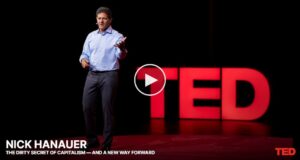
As I stated when I first mentioned Nick Hanauer a few posts ago, he is NOT an economist and he is NOT an MMT guy.
So why is he on this list? Why is he mentioned in this blog at all?
Because what he’s doing is incredibly interesting (at least to me) and has the potential to be very significant. If they’re successful.
Nick Hanauer
Nick Hanauer IS a capitalist.
Most people who live and work in capitalist societies and economies, if asked “Are you a capitalist?” will say “Yes”.
But they’re not. They’re workers. They earn money primarily through wages.
Nick Hanauer was working in his parent’s company that made and sold bedding and pillows and such stuff.
At that time he happened to meet and become friends with someone named Jeff Bezos and saw potential in Bezos.
Both of them seeing potential in the coming commercialization of the Internet, Nick offered to invest in whatever business Jeff started if he ever decided to start one.
This is how Nick became the first non-family investor in Amazon.
I read somewhere he invested $45,000 which a few years later was worth $20M.
This of course kickstarted his fortune.
Since then he has invested in 30 or so companies, most of which did well, and one of which was sold to Microsoft for $6.2B.
On a podcast episode I listened to, Nick Hanauer denied being a billionaire, but on the Internet, his net worth is reported as being $1B.
So why is he so interesting?
He has become somewhat of a traitor to his class by virtue of being a strong critic of how capitalism is done today, a strong advocate of what are normally thought of as “progressive reforms”, and a bit of an alarmist that if we don’t fix our economy, it’s going to get bad, really bad. French revolution bad.
His first TED talk is titled is “Beware, fellow plutocrats, the pitchforks are coming”.
He funds an advocacy group named Civic Ventures whose goal is to challenge conventional wisdom for the purpose of building social change.
One of the things Civic Ventures does is produce a podcast titled Pitchfork Economics, where they interview people involved in what I’ll call “modern economic thought” (which leans heavily to MMT) and actively promote what most people would think of as a progressive agenda.
He also funds another advocacy group named Civic Action, whose tagline is “Let’s cause some trouble”, and who states goals of:
- Passing a livable minimum wage
- Restoring overtime pay
- Taxing the rich
- Ending gun violence
- And other goals which again are normally thought of as being “progressive”.
I’ve read Nick also funded an effort in Seattle (he’s lived there most of his life) to raise the Seattle minimum wage to $15 an hour, which succeeded.
So why does a hard-core capitalist want workers to earn more?
Because everyone will do better if we “rescind” trickle-down economics, including himself and his fellow plutocrats who will do better as capitalists when people can afford to buy more of the stuff their companies sell.
Which makes sense when you think about it.