The economics of ecocide?
This, claims Professor Steve Keen, is one of the primary reasons why we need a new economics.
He makes the rather hyperbolic statement that neoclassical economics is the economics of ecocide precisely because it does not include the critical nature of energy in its economic modeling.
Plus the fact that is THE dominant economic school of thought guiding policymakers around the world.
So he claims, this gross underestimation of the role of energy to our production systems is causing neoclassical economics to downplay the effects of climate change, which is clearly already starting to occur.
Per economist William Nordhaus
In 1991, economist William Nordhaus said:
“… it is difficult to find major direct impacts of the project climate chantes over the next 50 to 75 years”.
Per Steve Keen, if energy was properly included in our economic modeling, these direct impacts would be obvious.
Nordhaus further said:
“approximately 3$ of United States national output is producted in highly sensitive sectors, another 10% in moderately sensitive sectors, and about 87% in sectors that are negligibaly affected by climate change”.
This ignores that 100% of production requires energy as an input.
Per the IPPC 2014 report
Note “2014”, as in not very long ago:
“Other economic activities, such as manufacturing and services, largely take place in controlled environments and are not really exposed to climate change”.
Which leads to stuff like…
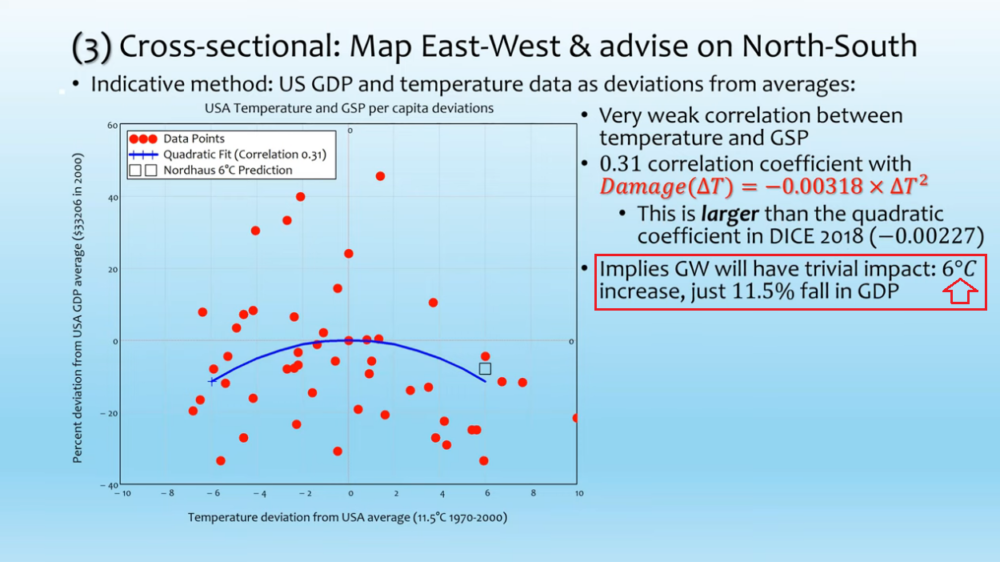
This is a model put together with data from Nordhaus. Please direct your attention to the red rectangle and the red arrow.
Apparently, an increase in the global temperate of 6 degrees Celsius (10.8 degrees Fahrenheit) will cause a drop in GDP of only 11.5%. While that is not good news, it doesn’t sound catastrophic.
But what do climate scientists and eco scientists say happens with an increase in global temperate of 6 degrees Celsius? See below, but it’s not good.
Which pits economic forecasts against ecological forecasts
While economists say a global temperature increase of 6 degrees Celsius would cause a decrease of GDP of only 11.5%, climate scientists and ecologists say a global temperature increase of 6 degrees Celsius would lead to the extinction of our species.
They claim that 2 degrees might push us beyond tipping points from which the ecosystem can’t recover (as once the increase is 2 degrees the existing feedback loops fail and there is then no stopping an increase to higher temperatures that will kill us), and we are already past 1 degree today.
This is why Steve Keen is calling neoclassical economics the economics of ecocide.
Now to be clear, the earth will survive. We just won’t be there to enjoy it
Believe it or not, his next few slides are even more depressing.
Neoclassical economists aren’t denying global warming is happening, they deny it matters
When one of your core beliefs is “capitalism can cope with anything”, global warming becomes something else it can deal with, and therefore it can’t be an existential threat.
Steve Keen is promoting that relative to the effects of global warming, economists should shut up, sit down, and listen to scientists.